Promoting the Practice of Global Education Among Young People in Africa
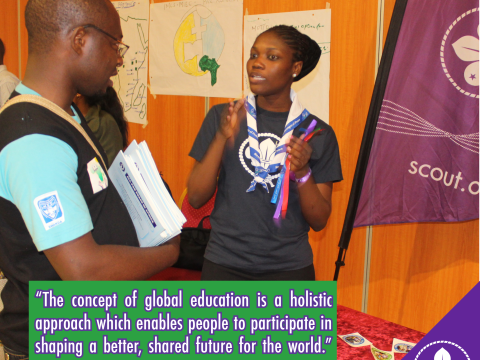
11 November 2015, Nairobi, Kenya: The Network of International Youth Organizations in Africa (NIYOA) is conducting a Training of Trainers Course on Global Education in the framework of the 7th African University on Youth and Development, that is currently taking place in Nairobi. The course, which has brought together over 20 young people from various international youth organizations working in Africa, aims to promote the practice of global education among young people and youth organizations in Africa.
Global Education is a holistic education that opens people’s eyes and minds to the realities of the world, and awakens them to bring about a world of greater justice, equity and human rights for all. It gives learners the opportunity and competences to reflect and share their own points of view and role within a global, interconnected society, as well as to understand and discuss complex relationships of common social, ecological, political and economic issues, so as to derive new ways of thinking and acting.
The need for global education is occasioned by the fact that global youth work today is getting more connected yet complex because young people live and interact in an increasingly globalized world; faced with similar challenges. This reality is getting more attention hence the consequent need for young people to network and take joint actions to address these common challenges.
The reality of this interconnectedness has seen increased cooperation between peoples, nations, institutions and regions. These cooperations have proven to be very useful in addressing many global issues.
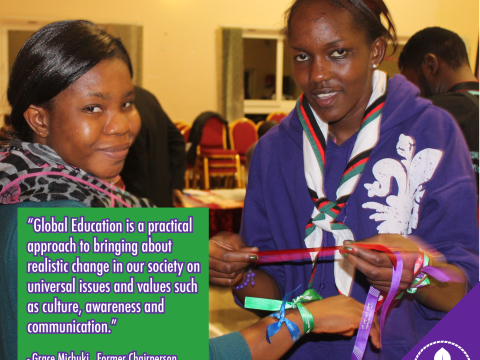
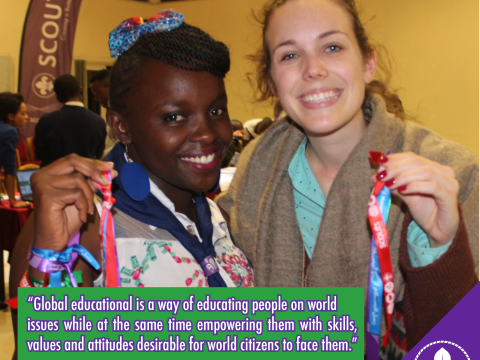
The World Organizations of the Scout Movement (WOSM) is being represented at the training by three young ladies: Pamela Akplogan, the Chairperson of the Youth Advisors to the Africa Scout Committee; Grace Michuki, the immediate former Chairperson to the Africa Scout Youth Committee and Grace Wanja a Rover Scout from Kenya Scouts Association.
We caught up with them, asked some questions and below is what they had to say:
1. What should we expect as they main outcomes of this course?
[Pamela Akplogan] We should expect the adoption of global education concepts and connection of young people through youth organizations by sharing experiences. The implementation of follow-up training activities that enhance the acquisition of key non formal education competencies will also be key. Another important thing is to create a pool of trainers in order to contribute to the promotion of global education in Africa.
[Grace Michuki] The main outcome from this training would be to familiarize ourselves with global education and its various approaches - formal, non-formal, informal learning.
[Grace Wanja] I expect that the trainees will come out as better trainers in all the fields of learning, from formal to informal to non-formal learning.
3. Scouting is a non formal education youth movement. What is the linkage between non formal and global education?
[Pamela Akplogan] Global education achieves its perspectives through a non formal education process. Scouting has always been practicing global education, taking in account the fact that the movement is open to all without discrimination; and the Scout Method is implemented in each country based on shared values and unique realities.
[Grace Michuki] Scouting has youth engagement and educational methods as core parts of its youth programmes which are approached in a holistic and inclusive way that takes into consideration the global changes in society.
[Grace Wanja] The values under non-formal education are very similar to what Scouting espouses and what the movement aims to see in the Scouts - tolerance and respect for others, gender equality, peace education and responsibility among others. Global education, just as non-formal education in Scouting, is intentional and voluntary.
The training course end on 15 November 2015.