Leading every day: women across five regions shaping Scouting's future
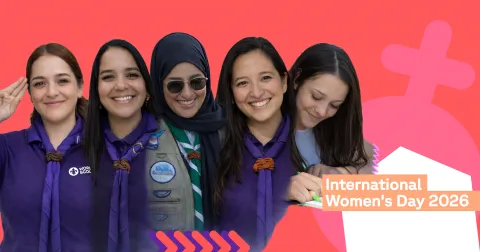
UN Women's theme for 2026 is clear: Rights. Justice. Action. For ALL Women and Girls. Across the Scout Movement, women and girls are living that call. They are leading environmental camps, training the next generation of leaders, volunteering in their communities, and making Scouting's voice heard. Their journeys are different. So are their challenges. But in every region of the world, they share one thing in common: they are not waiting.
In Grahovo, a small rural community in Montenegro, Ana Vučković has been a Scout since she was seven. She learned early that protecting nature is not something you read about. It is something you do. In October 2025, Ana took part in a three-day training on environmental protection, organised as part of the Rise and Lead project, funded through the Youth Empowerment Fund in Europe. The training brought 25 young people together to develop skills in sustainability, leadership, and local environmental action.
"Protecting nature is not only about saving animals and plants," the 14-year-old said. "It is about ensuring a sustainable environment where everyone can thrive."
Back home, Ana is already planning clean-up days, biodiversity workshops, and eco-games: activities that make sustainability meaningful and fun for her peers. Her goal is simple. She wants every young woman who wants to lead for the planet to have the space and support to do so. Scouting gave her that space, and she intends to pass it on.
Across the Atlantic, in Willemstad, Curaçao, more than 30 Scout leaders from 12 countries gathered at the 29th Interamerican Scout Conference in November 2025. A dedicated workshop on women's leadership gave participants space to name barriers, learn from one another, and take action. Across the region, women still face gender stereotypes, limited time due to family responsibilities, and traditional expectations that can make leadership feel out of reach. Even within Scouting, these barriers show up.
"Women's leadership is essential to the mission of Scouting," participants concluded. "Together, we shape a future where everyone leads."
The Conference went further than words. When the time came to elect the Interamerican Scout Committee for the 2025-2028 triennium, Member Organizations chose eight voting members and two Youth Advisors from a competitive field of candidates. Among the eight voting members elected, women form the majority. It is a result that reflects years of sustained effort to make governance as diverse as the Movement itself, and a sign that structural change is already under way.
In Saudi Arabia, Manayer al Dabbas did not stop at earning her Wood Badge, the internationally recognised Scout leadership qualification. She became a trainer herself, equipping other women with the same skills that had changed her own path. Manayer is part of the Saudi Rovers project, a partnership between World Scouting, the Saudi Arabia Scout Association, and Alwaleed Philanthropies, which establishes Rover Scout groups for women at Saudi universities. The project offers leadership development, community service, and skills training aligned with both Scouting values and the country's Vision 2030.
At King Khalid University in early 2024, Manayer co-led a second-level leadership training for 25 women, each now qualified to build and run their own Scout group on campus. More than 150 girls in Scouting went on to volunteer during the Haj season, supporting pilgrims at Al-Masjid Al-Haram. For Manayer, every woman she trains is a multiplier. Her vision for this International Women's Day is a Scout Movement in the Arab Region where qualified female leaders are not the exception. They are the norm.
At the 2024 Africa Scout Day celebrations in Bujumbura, Burundi, Ledet Yosef took to the stage with a direct message for the young Scouts in the room. "Step out of your comfort zones," she told them.
"Engage fully with the world around you and seek out opportunities to serve and lead with integrity and compassion."
As a member of the Africa Scout Committee, Ledet has spent years working to ensure those words carry institutional weight, backed by structures, mentorship, and resources that help young women lead. Africa is the Scout Movement's fastest-growing region, with nearly 10 million members, among them 3.9 million girls and women. That number represents both progress and responsibility. Ledet's message to adult leaders is equally clear: become mentors and role models. Create an environment where young people can discover their potential, not just hear about it.
Across the Asia-Pacific Region, young women are proving that peace is not simply the absence of war. Through the Young Ambassadors for Peace programme, inspired by the Messengers of Peace initiative, Scouts from the mountains of Nepal to the islands of Indonesia are leading projects that transform communities. Through intercultural dialogue and conflict resolution, they are showing that peace is built through concrete actions for mutual understanding, whether by promoting tolerance in schools or leading community service projects.
The programme equips them with practical tools and skills, but it also gives them a voice. These young women are turning conflict into opportunities for growth and doing so as agents of change in their own communities.
In 2026, the International Year of Volunteers, these stories are a reminder of what it means to give your time and skills in service of something bigger. Each of these women is a volunteer. Each is a leader. And each is part of a Movement that is not standing by while the gap closes on its own. The Scout Movement is actively working to close it out faster, because the future of Scouting is already here and cannot wait.