Scouting: learners and educators co-creating educational experiences
By João Armando P. Gonçalves, PhD, Chief Education and Development Officer, World Scouting
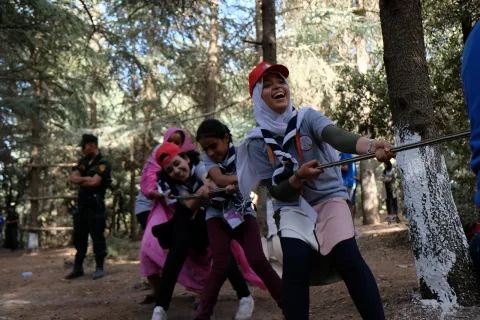
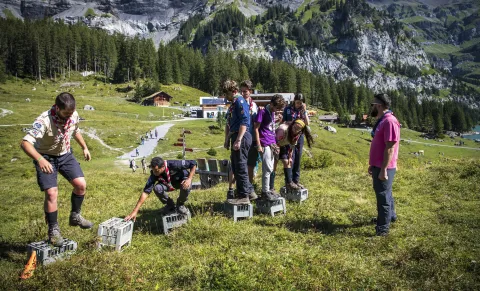
There are more than 1 million places around the globe where, every week, young people gather and actively participate in a series of activities and games to learn how to collaborate, be autonomous, lead, be creative, express themselves, relate, contribute to their communities, and be resourceful, among many other learnings.
Is this education? It certainly is if we have a holistic view of a young person's development. This is what Scouting has been all about for almost 120 years.
Those 1 million learning environments are local Scout groups and can be based in diverse settings - from community centres and schools to sports clubs and public parks, to even refugee settlements, prisons, and religious facilities.
Collectively, they support 60 million young people in 222 countries and territories. These groups are the cradle of adventures, friendships, exchanges, plans, projects, expeditions, experiments, reflections, and discoveries that enable young people to grow and flourish. Scouting provides safe, fun, and inclusive spaces for them to shape their own experiences and, in turn, influence their personal development.
As a non-formal education movement, Scouting can be described as a semi-structured learning environment where meaningful educational experiences are lived by young people. These experiences are not simply provided. They are co-created with peers and Scout leaders (the educators).
For some, the idea of young people shaping their own learning experiences may seem unusual. Yet, placing young people at the centre of the educational process, namely choosing “what to do”, has been a defining feature of Scouting since its inception in 1907. Robert Baden-Powell, Scouting’s founder, used to tell Scout leaders: “Ask the boy [and girl … since the 1960s] - he can tell you what he wants, and how he wants it.”
As the utilitarian approach to education (“you are educated to earn a living as a cog in the production machine”) is increasingly questioned, a more holistic and human-centred approach is gaining ground. Education is no longer just about learning a trade or having a degree, but about preparing individuals to make choices, cope with uncertainty, pursue happiness, collaborate with others for the common good, practice self-care, develop a set of values, think critically, and acquire future-proof competencies and skills to navigate through the seas (and storms!) of life.
Expecting schools to provide all this on top of other foundational learnings, such as reading, writing, math, history, or science, is simply unrealistic. Recognising other organisations that work with youth as part of the broader educational ecosystem is therefore essential. As the well-known proverb states: “It takes a village to raise a child.”
While the bulk of the learning experiences that happen in Scouting are shaped at the local level through Scout groups, the global nature of the Scout Movement opens the door to shared visions and collective priorities, also at an educational level. World Scouting, which exists to support, grow and amplify the impact of the Scout Movement, has set a clear vision for the future: To be the world’s most inspiring and inclusive youth movement creating transformative learning experiences for every young person, everywhere.
On the other hand, for some years now, Scout groups have begun to include more and more activities related to issues that are critical for our collective future - peace, sustainability, health and well-being, and life skills. In that sense, as an educational movement, Scouting becomes locally rooted, but globally mindful - an idea best exemplified through Scouts for SDGs, a global mobilisation initiative to make a difference in the world, one community at a time.
As we mark this year’s International Day of Education, UNESCO reminds us of the power of youth in co-creating education and encourages individuals and institutions to work on “meaningfully engaging students and youth in co-creating the education they want”. As the world's largest educational youth movement, Scouting is committed to building on our long history of engaging young people as co-designers of their own transformative learning experiences. And making sure those experiences are rooted in healthy, safe intergenerational partnerships with well-trained volunteer educators.
Together, we believe this is a proven recipe for success that will continue to create generations of individuals who are ready for life.